

Arton-DL – removed from production
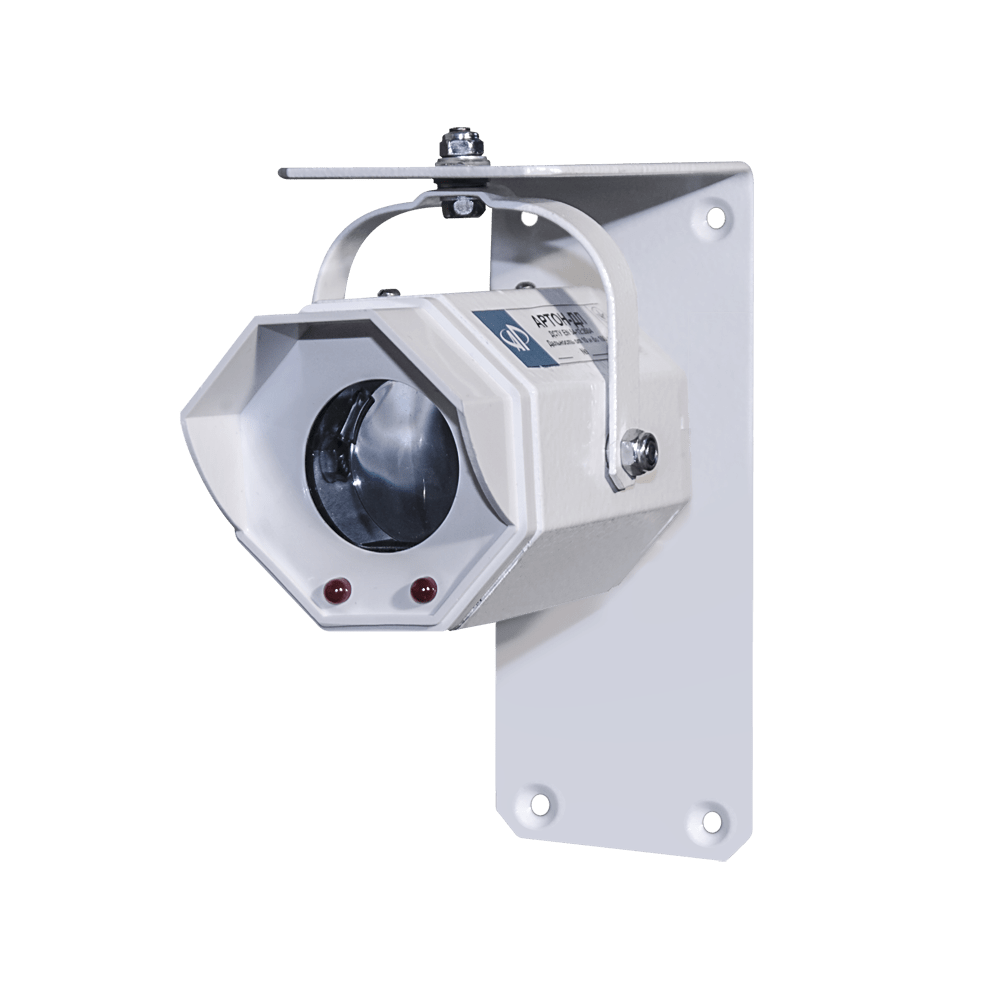
Product description 
The detector is designed to detect flashes in closed rooms of large sizes, accompanied by the appearance of smoke.
- Applications: large indoor spaces, including spaces with original ceiling configurations (churches, theaters, museums)
- Intelligent microprocessor data processing provides better detection of different types of fires at an earlier stage, including "black smoke", which is difficult to detect with point detectors, and eliminates false alarms
- 2-position: the receiver unit and the emitter unit in the same housing, located on opposite sides of the protected area
- Indication: two red indicators on each block, which display the states - "Duty mode", "Fault" mode and "Fire" mode
- Mounting: corner and arch brackets (also used for mechanical adjustment of detectors)
- Metal cases: provide additional protection against false positives
- Range and Calibration switches on the back of the receiver
- 2 attenuators are used to adjust and check the sensitivity (included in the delivery set)
- Connection: 2-wire, 4-wire - using the MUSH-DL module
Specifications
Characteristic
Value
Supply voltage:
10 - 30 V
Current consumption in standby mode:
2 mA
Overall dimensions:
no more than 65 × 65 × 110 mm
Mass:
no more than 0.6 kg
The presence of an indication of the standbyy mode:
Yes
Maximum permissible current in FIRE mode:
8 ± 1.6 mA
Range of action:
10 - 100 m
Useful materials
| Name | Country | Comment | Open | Download |
|---|---|---|---|---|
| Manual | russian | |||
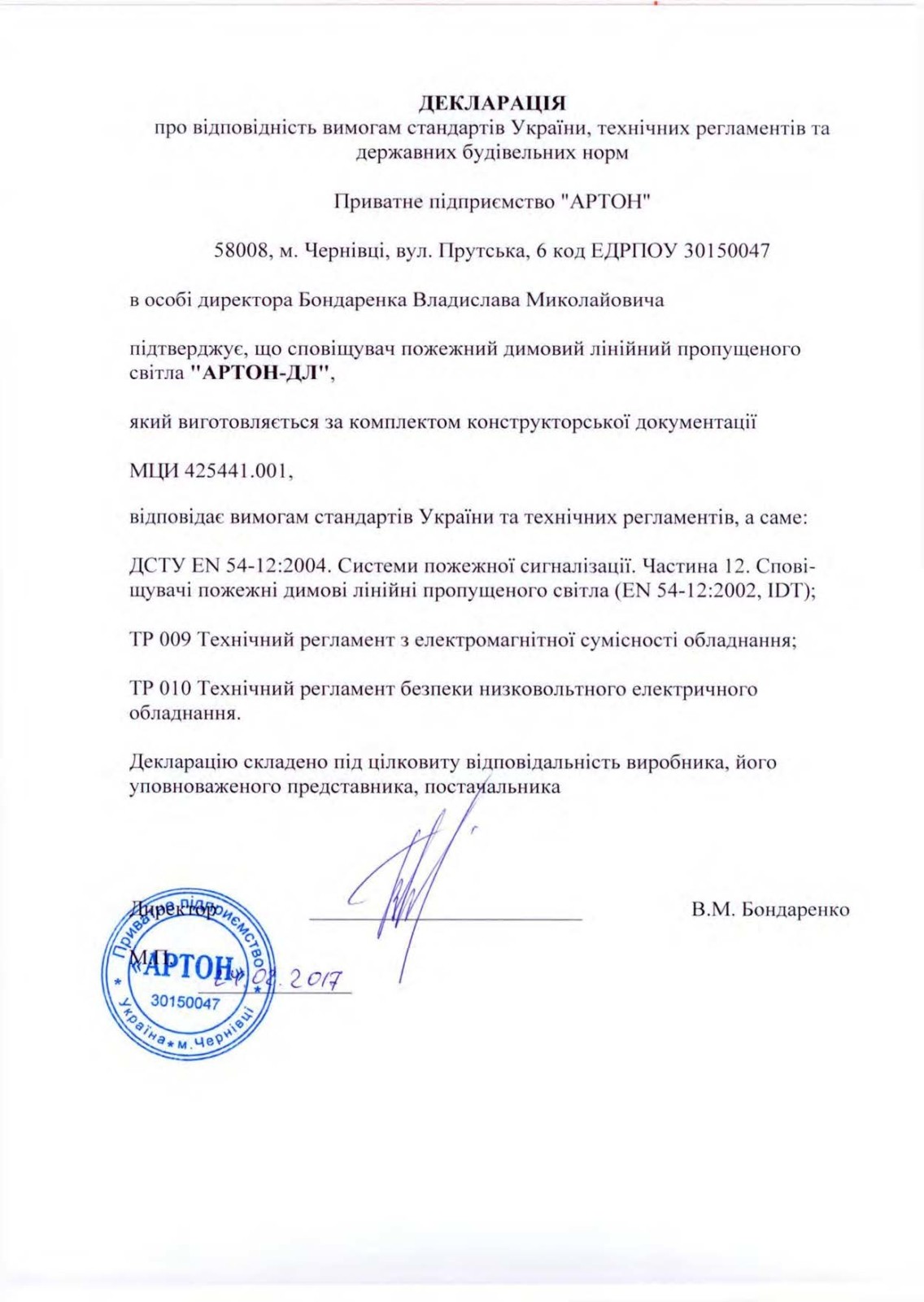
| DOP | UA(Ukraine) | Declaration of compliance with the requirements of Ukrainian standards | ||
| Сertificate | RU(russia) | expired | ||
| Scheme | wearing diagram | |||
| Archive | Packaged archive files of instructions, passports and photos of the device |
Devices with which it is used
Questions and answers
Placement of linear fire detectors “ARTON-DL” is carried out in full compliance with DBN V.2.5-56-2014. In rooms with a height of more than 11 meters, ARTON-DL detectors should be installed in two tiers, while the distance from the floor level to the lower tier should be at least 4 meters, the maximum distance between the detectors is not more than 9 meters, the maximum distance from the detectors to walls – 4.5 meters (see Table 6.4 DBN V.2.5-56-2014).
According to DBN V.2.5-56-2014 “Fire Protection Systems”, regulatory requirements for installing fire line detectors are given in paragraphs 6.2.16 – 6.2.19
It is possible to organize the operation of the module in two modes:
– nominal load;
– maximum load;
In the mode of nominal load, a break in any place of the SH will be perceived by the MUSH-DL as a malfunction.
In the nominal load mode, the total current consumption of the detectors should not exceed the module break threshold. The maximum number of notifiers is determined by the formula:
Nspov = Iobr / Ichr (1)
where Nspov is the maximum number of detectors in the system; Iobr — the threshold for determining the state “Cliff” by the MUSH-DL device; Ichr is the current consumption of the detector in standby mode.
For mass-produced IP-2.1 detectors and the MUSH-DL module:
Iobr = 1.6 mA
Ichr = 0.22 mA
Nspov = 1.6/0.22 ≈ 7 pcs.
For mass-produced detectors SPD-3 (IPD-3), SPD-3.1 (VPS-3.1), SPD-3.1m (VPS-3.1m) and the MUSH-DL module:
Iobr = 1.6 mA
Ism = 0.09 mA
Nspov = 1.6/0.09 ≈ 17 pcs.
In the nominal load mode, it is recommended to set such a terminating resistor so that the total current flowing through Rok and consumed by the detectors is within 4 mA, i.e.:
Ial = Ual / Rok + Ism * Nspov (2)
where Ial is the total current in the signaling loop; Ual is the nominal voltage in the signaling loop; Ispov is the total current consumed by the detectors in standby mode. Ism — current consumption of the detector in standby mode. Nspov — the number of installed detectors in the AL;
Thus
Year = Ual / (Ial – Ism * Nspov)
Year = 12V / (4mA – 0.22mA * 7) ≈ 4.7 kΩ
Connection of several “ARTON-DL” linear fire detectors to one fire alarm loop is possible only with the use of “MUSH-DL” coordination modules, and the number of “MUSH-DL” must correspond to the number of “ARTON-DL”. The connection is made according to the scheme: View
No, you can’t. Only one RT-2 cable adapter can be connected to one fire line according to the connection scheme indicated in its passport.
The linear smoke detector Arton-DL is connected to the reception and control devices of the fire department, security and fire department, to devices with sign-changing loops only with the help of the MUSH-DLM loop matching module according to the connection diagrams.
Note. The Arton-DL smoke linear detector is connected to the devices of the “Arton” and “Vector” fire receiving and control series manufactured by PP “Arton” without the use of the MUSH-DLM loop matching module.
Educational materials
Click to view komponenty_spz_612.pdf